Introduction
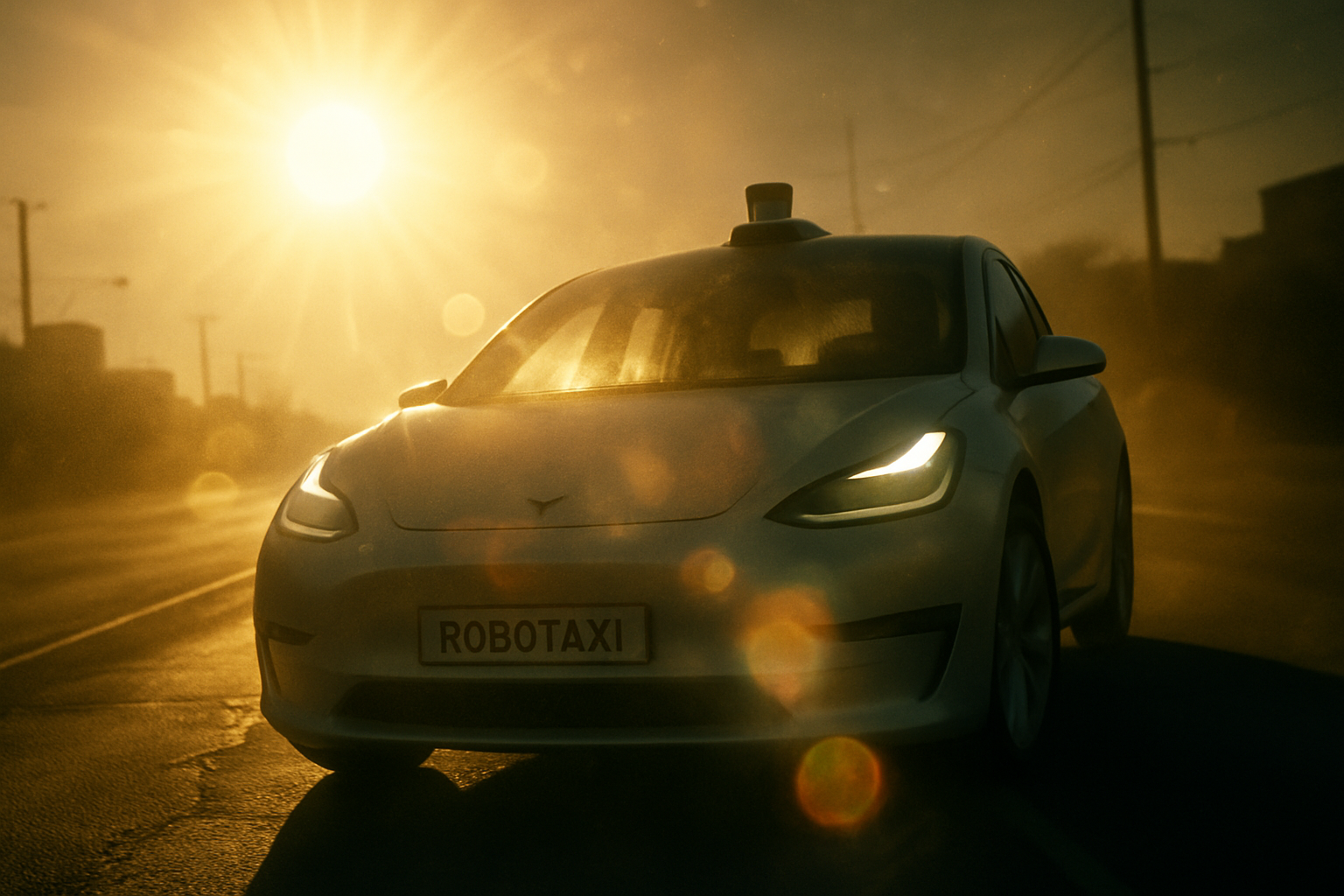
As a Tesla owner, you are likely well aware of Tesla’s ambitious goals in autonomous driving. However, as Tesla’s Robotaxi service gradually becomes a reality, a seemingly simple yet highly challenging factor has emerged: the sun. This article will delve into how sunlight poses the biggest challenge for Tesla’s Robotaxi and how Tesla is addressing this “bright” problem.
The Sun’s “Blind Spot”: The Dilemma of Vision Systems
Tesla’s autonomous driving system primarily relies on cameras for environmental perception. In most cases, this vision system performs excellently. However, when the vehicle directly faces intense sunlight, or during sunrise and sunset when the sun shines at a low angle, the cameras may experience “glare,” leading to blurry images, reduced contrast, and even temporary “blind spots.”
For human drivers, our brains can quickly adapt and filter out these interferences. But for autonomous driving systems that rely on precise image recognition, this can lead to misjudgments, such as “phantom braking”—where the vehicle suddenly brakes even when there are no obstacles ahead. This phenomenon not only affects ride comfort but also poses potential safety risks.
Tesla’s Strategy: Software Optimization and Data Accumulation
Facing the challenges posed by sunlight, Tesla is making multi-faceted efforts to address them:
•Software Algorithm Optimization: Tesla continuously updates its FSD (Full Self-Driving) software, using more advanced image processing algorithms to identify and filter out interference caused by sunlight. This includes leveraging neural networks to learn real-world data under various lighting conditions, thereby improving the system’s robustness in complex light environments.
•Data Accumulation and Simulation: Tesla has a vast fleet of vehicles that collect massive amounts of real-world driving data every day. This data, including driving scenarios under various sunlight conditions, is used to train and optimize its neural networks. Additionally, Tesla utilizes powerful simulators to simulate extreme lighting conditions, accelerating algorithm iteration and validation.
•Hardware Improvements: While Tesla adheres to a pure vision solution, it does not rule out future improvements to camera hardware, such as using sensors with higher dynamic range or special filters, to further enhance the system’s performance in strong light.
Impact on Tesla Owners: A Gradually Improving Experience
As a Tesla owner, you will be a witness and participant in Tesla’s efforts to overcome this challenge. Every FSD software update may include optimizations for sunlight issues. While you might still encounter some “phantom braking” or other sun-induced driving behaviors, these issues will gradually be resolved as the technology continues to advance.
This means your Tesla will become increasingly intelligent and capable of adapting to various complex driving environments. Ultimately, when the Robotaxi service is fully widespread, you will be able to enjoy safe and reliable driverless travel in any weather and lighting conditions.
Looking Ahead: Beyond the Challenge of Sunlight
Sunlight is just one of many challenges facing autonomous driving technology. Adverse weather conditions such as rain, snow, and fog, as well as complex road conditions like worn road markings and construction zones, all place higher demands on autonomous driving systems. Tesla’s approach of tackling these challenges with a pure vision solution demonstrates its firm belief in its technological path.
As Tesla makes progress in addressing environmental challenges like sunlight, the future of Robotaxi will become even brighter. As Tesla owners, we have reason to believe that Tesla will continue to lead the development of autonomous driving technology, bringing us a safer, more efficient, and more convenient future of mobility.